
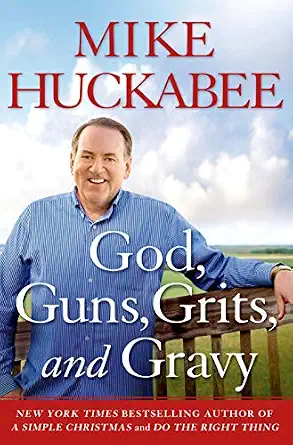
In every generation, books emerge that attempt to explain the social and political changes shaping their country. Some offer historical analysis, while others present deeply personal perspectives on the challenges facing society. God, Guns, Grits, and Gravy: And the Dad-Gummed Gummint That Wants to Take Them Away by Mike Huckabee is one such book. Written by the former Governor of Arkansas and presidential candidate, it examines the growing cultural and political divisions within the United States from a conservative viewpoint.
Published in 2015, the book argues that America is increasingly divided between two very different ways of life. Huckabee introduces readers to what he calls “Bubble-ville” and “Bubba-ville,” two symbolic communities that represent contrasting values, lifestyles, and political beliefs. Through personal stories, humor, political observations, and commentary on current events, Huckabee presents his concerns about faith, family, government, and the future of American culture.
Whether readers agree or disagree with his conclusions, God, Guns, Grits, and Gravy offers valuable insight into one side of America’s ongoing cultural conversation.
About the Author
Mike Huckabee is an American politician, author, Baptist minister, and television personality. He served as the 44th Governor of Arkansas from 1996 to 2007 and later became a prominent figure in national politics through his presidential campaigns and media appearances.
Throughout his career, Huckabee has advocated for conservative principles, emphasizing religious liberty, limited government, fiscal responsibility, and traditional family values. His background in both politics and ministry shapes much of his writing, giving readers a blend of personal experience, political commentary, and faith-based reflection.
In God, Guns, Grits, and Gravy, Huckabee uses his years in public service to explain why he believes America is experiencing a growing cultural divide.
Book Overview
At its core, God, Guns, Grits, and Gravy explores the differences between two symbolic versions of America.
Huckabee refers to these groups as:
- Bubble-ville
- Bubba-ville
These names are not meant to describe specific people but rather represent different cultural attitudes.
According to Huckabee:
Bubble-ville represents America’s political, media, and cultural elites, often associated with major metropolitan areas. He argues that this group tends to support progressive social policies, expanded government programs, and changing cultural norms.
Bubba-ville, on the other hand, symbolizes small-town America, where faith, patriotism, family traditions, self-reliance, and community remain central values.
The book examines how these differing worldviews contribute to political disagreements and cultural debates across the country.
America’s Growing Cultural Divide
The central theme of the book is polarization.
Huckabee argues that Americans increasingly view one another through cultural and political labels instead of shared national values.
He believes this divide extends beyond elections and political parties.
Instead, it affects discussions about:
- Religion
- Education
- Entertainment
- Family
- Government
- Freedom
- National identity
Throughout the book, Huckabee suggests that understanding these cultural differences is essential for addressing many of the nation’s challenges.
The Role of Faith
Faith plays a major role in Huckabee’s worldview.
He argues that religious belief has historically shaped America’s moral foundation and continues to influence millions of citizens.
The book expresses concern that religion has become less influential in public life, particularly in schools, government institutions, and popular culture.
Huckabee believes protecting religious freedom allows individuals and communities to live according to their deeply held beliefs while contributing positively to society.
Whether readers share his perspective or not, the discussion highlights the continuing role of religion in American public life.
Gun Rights and Personal Responsibility
As the title suggests, firearms represent another important topic.
Huckabee discusses the Second Amendment not only as a constitutional issue but also as a symbol of personal responsibility and individual liberty.
He argues that responsible gun ownership reflects values such as:
- Independence
- Self-defense
- Constitutional rights
- Civic responsibility
The book also explores the broader debate surrounding gun laws and government regulation, presenting Huckabee’s perspective on why many Americans view firearm ownership as an important part of their identity and freedoms.
Government and Individual Freedom
Another recurring theme is the proper role of government.
Huckabee believes government should perform essential public functions while avoiding unnecessary interference in people’s daily lives.
He criticizes what he views as excessive bureaucracy, regulation, and federal spending.
Instead, he advocates for:
- Smaller government
- Greater personal responsibility
- Local decision-making
- Fiscal discipline
- Constitutional limits on government power
Readers interested in conservative political philosophy will recognize these ideas as longstanding principles within American political thought.
Family and Community Values
Throughout the book, Huckabee emphasizes the importance of strong families and close-knit communities.
He argues that healthy societies depend on:
- Stable families
- Respect for neighbors
- Volunteerism
- Civic engagement
- Shared moral values
Rather than relying primarily on government programs, Huckabee believes communities should solve many social problems through cooperation, faith-based organizations, charities, and local leadership.
These discussions reflect one of the book’s most consistent messages: meaningful change often begins at the community level.
Media and Popular Culture
Huckabee also examines the influence of modern media.
He argues that many national media organizations and entertainment companies present perspectives that do not always reflect the values of Americans living outside major cities.
The book discusses:
- Television
- News reporting
- Celebrity culture
- Social trends
- Public opinion
According to Huckabee, this disconnect contributes to misunderstandings between different parts of American society.
His observations encourage readers to think critically about how media shapes public conversations and cultural identity.
Patriotism and National Identity
Love of country is another important theme.
Huckabee frequently reflects on America’s founding principles, including:
- Individual liberty
- Constitutional government
- Freedom of religion
- Free enterprise
- Civic responsibility
He argues that preserving these values requires active participation from citizens rather than reliance on political leaders alone.
The book encourages readers to appreciate American history while remaining engaged in shaping the nation’s future.
Humor and Personal Stories
One of the book’s strengths is its conversational writing style.
Rather than presenting only political arguments, Huckabee shares stories from:
- His childhood
- His years as governor
- Campaign experiences
- Encounters with everyday Americans
These personal anecdotes add warmth and humor to the book while making complex political discussions easier to understand.
His storytelling style keeps the book engaging even when discussing controversial topics.
Writing Style
God, Guns, Grits, and Gravy is written for a broad audience rather than political experts.
Huckabee avoids overly technical language and instead uses:
- Humor
- Personal experiences
- Historical examples
- Political observations
- Cultural commentary
His conversational tone makes the book accessible even for readers who do not regularly follow politics.
While the arguments reflect a clear conservative perspective, the writing remains engaging and easy to follow.
Strengths of the Book
Several qualities make this book stand out among political commentary.
Clear Perspective
Huckabee openly presents his beliefs, allowing readers to understand his viewpoint without ambiguity.
Engaging Storytelling
Personal stories make political discussions more relatable.
Accessible Writing
The book avoids unnecessary jargon, making it approachable for general readers.
Thought-Provoking Topics
Regardless of political affiliation, the book raises questions about faith, culture, freedom, and national identity that encourage discussion.
Timely Themes
Although published in 2015, many of the issues explored—including political polarization, media influence, and debates over government—remain highly relevant today.
Who Should Read This Book?
This book is recommended for:
- Readers interested in American politics
- Conservatives seeking a reflection on modern culture
- Students studying political communication
- Readers interested in contemporary social debates
- Those who want to understand one influential conservative perspective on America’s cultural divisions
Readers with different political viewpoints may also find value in the book as a way to better understand ideas that have shaped public debate in the United States.
Key Takeaways
Some of the book’s most important lessons include:
- America is experiencing significant cultural and political polarization.
- Faith continues to play an important role in many communities.
- Constitutional rights remain central to political debate.
- Strong families and local communities contribute to a healthy society.
- Government should balance public responsibilities with individual freedoms.
- Understanding differing perspectives is essential for productive civic dialogue.
Conclusion
God, Guns, Grits, and Gravy is a lively and opinionated examination of American culture, politics, and identity from Mike Huckabee’s conservative perspective. By introducing the concepts of “Bubble-ville” and “Bubba-ville,” Huckabee offers a framework for understanding the social and political differences that, in his view, define much of modern America.
The book combines personal anecdotes, humor, and political analysis to discuss topics such as faith, constitutional rights, the role of government, family values, and media influence. While readers may agree or disagree with Huckabee’s arguments, the book provides a clear and accessible look at one influential viewpoint within contemporary American conservatism.
For anyone interested in understanding the cultural debates that continue to shape the United States, God, Guns, Grits, and Gravy serves as both a political commentary and a reflection on the values and concerns of many Americans. It encourages readers to think critically about the relationship between government, community, personal responsibility, and national identity.