
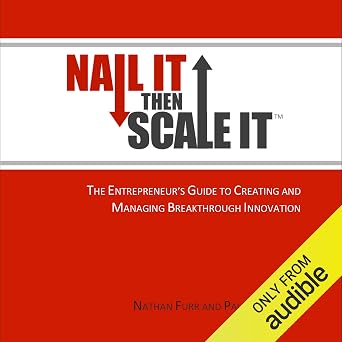
Every entrepreneur dreams of building the next breakthrough company. Yet, despite brilliant ideas, innovative products, and passionate founders, most startups fail within their first few years. The reasons are often the same: they grow too quickly, build products customers don’t need, or spend valuable resources before proving that their business model actually works.
In Nail It Then Scale It: The Entrepreneur’s Guide to Creating and Managing Breakthrough Innovation, entrepreneurship experts Nathan Furr and Paul Ahlstrom challenge the conventional wisdom that startups should focus on rapid growth from day one. Instead, they introduce a simple but transformative philosophy: first nail your business model, then scale your business.
Drawing on years of research, startup case studies, and practical business experience, the authors provide entrepreneurs with a proven roadmap for turning innovative ideas into successful companies. Rather than relying on luck or intuition, they encourage founders to test assumptions, validate customer demand, and build sustainable businesses before pursuing aggressive expansion.
Whether you’re launching your first startup, managing a growing company, or simply interested in entrepreneurship, Nail It Then Scale It offers timeless lessons that can significantly improve your chances of success.
About the Authors
Nathan Furr is an internationally recognized innovation expert, entrepreneur, professor, and author who specializes in entrepreneurship, venture creation, and technological innovation. His research focuses on helping startups reduce uncertainty and develop successful business models.
Paul Ahlstrom is an experienced entrepreneur, venture capitalist, and startup advisor with decades of experience investing in and mentoring early-stage companies. Having worked closely with hundreds of entrepreneurs, he brings practical insights into the challenges startups face when moving from idea to execution.
Together, Furr and Ahlstrom combine academic research with real-world business experience to create a practical guide that is both informative and highly actionable.
Book Overview
At its heart, Nail It Then Scale It argues that many entrepreneurs fail because they confuse growth with success.
Founders often believe they need to:
- Raise investment immediately
- Hire large teams
- Expand into multiple markets
- Spend heavily on marketing
- Build complex products
The authors argue that these steps should come after entrepreneurs have demonstrated that customers genuinely value their product.
Instead of rushing toward expansion, startups should first validate their assumptions through customer feedback, experimentation, and continuous learning.
Only after achieving product-market fit should a company begin scaling.
This straightforward concept forms the foundation of the entire book.
The “Nail It” Phase
The first half of the book focuses on what the authors call the Nail It stage.
This phase is about reducing uncertainty before making major investments.
Entrepreneurs are encouraged to answer several essential questions:
- Does the problem truly exist?
- Who experiences this problem?
- Is the problem important enough to solve?
- Will customers pay for a solution?
- Can the business generate sustainable profits?
Rather than making assumptions, founders should gather evidence through real customer interactions.
The goal is not to build the perfect product immediately.
The goal is to learn.
Customer Discovery Comes First
One of the book’s strongest messages is the importance of customer discovery.
Many entrepreneurs become emotionally attached to their ideas.
Unfortunately, customers don’t buy ideas.
They buy solutions to real problems.
The authors recommend spending significant time talking directly with potential customers.
This involves:
- Conducting interviews
- Observing customer behavior
- Asking open-ended questions
- Testing assumptions
- Collecting honest feedback
These conversations often reveal unexpected insights that reshape the business model.
By understanding customers before building products, startups dramatically reduce their chances of failure.
Building a Minimum Viable Product
Rather than spending years developing a perfect product, the book encourages entrepreneurs to create a Minimum Viable Product (MVP).
An MVP includes only the essential features necessary to solve a customer’s primary problem.
Launching early provides several advantages:
- Faster customer feedback
- Lower development costs
- Reduced financial risk
- Quicker learning
- Greater flexibility
Instead of guessing what customers want, entrepreneurs allow customers to guide product improvements.
Product-Market Fit: The Ultimate Goal
According to the authors, every startup should focus on achieving product-market fit before thinking about rapid growth.
Product-market fit occurs when:
- Customers love the product.
- Sales become more predictable.
- Customer retention improves.
- Positive word-of-mouth increases.
- Revenue begins growing consistently.
Without product-market fit, even the best marketing campaigns cannot create sustainable success.
Many startups fail because they attempt to scale businesses that haven’t yet solved meaningful customer problems.
Learning Through Experimentation
One of the book’s most valuable lessons is treating entrepreneurship as a process of experimentation.
Every startup begins with uncertainty.
Rather than assuming founders already know the answers, Furr and Ahlstrom encourage entrepreneurs to test every important assumption.
Experiments might include:
- Landing pages
- Prototype demonstrations
- Pricing tests
- Pilot programs
- Customer interviews
- Limited product launches
Each experiment generates valuable information.
Successful entrepreneurs learn quickly and adjust accordingly.
Building the Right Team
Ideas alone rarely build successful companies.
The book emphasizes assembling teams with complementary strengths.
Effective startup teams combine expertise in areas such as:
- Product development
- Marketing
- Finance
- Sales
- Customer support
- Leadership
The authors also stress the importance of hiring people who embrace uncertainty and remain willing to learn as the business evolves.
Strong teams adapt faster when unexpected challenges arise.
The Importance of Business Models
Many entrepreneurs focus exclusively on creating innovative products.
The authors argue that innovation alone is not enough.
A successful startup also requires a viable business model.
Founders must understand:
- Who their customers are
- How revenue will be generated
- What costs must be managed
- Which distribution channels work best
- How the company creates long-term value
The business model deserves as much attention as the product itself.
The “Scale It” Phase
Only after validating the business model should entrepreneurs move into the Scale It stage.
Scaling involves growing the business systematically.
This may include:
- Hiring employees
- Expanding production
- Entering new markets
- Raising investment
- Building operational systems
- Increasing marketing efforts
Because the company has already validated customer demand, expansion becomes far less risky.
The authors repeatedly remind readers that scaling too early is one of the leading causes of startup failure.
Common Startup Mistakes
Throughout the book, Furr and Ahlstrom identify mistakes that repeatedly prevent startups from succeeding.
These include:
- Falling in love with the product instead of the customer.
- Spending too much money too early.
- Ignoring customer feedback.
- Hiring too quickly.
- Scaling before achieving product-market fit.
- Relying on assumptions instead of evidence.
Recognizing these common errors allows entrepreneurs to avoid expensive setbacks.
Writing Style
One of the book’s greatest strengths is its clarity.
Although entrepreneurship can be a complex subject, the authors explain concepts using:
- Real startup stories
- Practical examples
- Simple frameworks
- Step-by-step guidance
- Actionable advice
The writing is accessible enough for first-time founders while remaining valuable for experienced entrepreneurs.
Readers finish each chapter with practical ideas they can immediately apply to their own businesses.
Why This Book Still Matters
Startup ecosystems have evolved dramatically since the book’s publication.
Artificial intelligence, remote work, digital marketing, and online platforms have transformed entrepreneurship.
Yet the core principles remain remarkably relevant.
Businesses still succeed by:
- Solving meaningful problems.
- Understanding customers.
- Testing assumptions.
- Learning continuously.
- Growing only after validating demand.
These timeless lessons make Nail It Then Scale It just as valuable today as when it was first published.
Strengths of the Book
Several qualities distinguish this book from many other entrepreneurship guides.
Practical Advice
The authors provide actionable frameworks rather than abstract theories.
Customer-Centered Thinking
The book constantly reminds entrepreneurs that customer needs drive successful innovation.
Evidence-Based Decision Making
Rather than relying on intuition, founders are encouraged to test assumptions.
Excellent Balance
The book combines academic research with practical startup experience.
Applicable Across Industries
The lessons apply equally well to technology startups, service businesses, manufacturing companies, and social enterprises.
Who Should Read This Book?
Nail It Then Scale It is highly recommended for:
- Startup founders
- Entrepreneurs
- Small business owners
- Product managers
- Innovation consultants
- Venture capital investors
- MBA students
- Business students
- Corporate innovation teams
Whether launching a technology startup or a local business, readers will find practical strategies for reducing risk and improving decision-making.
Key Takeaways
Some of the book’s most important lessons include:
- Validate customer demand before investing heavily.
- Conduct continuous customer discovery.
- Build a Minimum Viable Product instead of a perfect product.
- Test business assumptions through experimentation.
- Achieve product-market fit before scaling.
- Assemble teams with complementary skills.
- Base business decisions on evidence rather than optimism.
- Sustainable growth follows successful validation.
Conclusion
Nail It Then Scale It is one of the most practical and insightful books available for entrepreneurs seeking to transform ideas into successful businesses. Nathan Furr and Paul Ahlstrom challenge the common belief that rapid growth should be a startup’s primary objective. Instead, they argue that long-term success begins with understanding customers, validating assumptions, and building a business model that genuinely solves real problems.
The book’s greatest strength is its emphasis on disciplined learning. By encouraging entrepreneurs to test ideas, gather feedback, and adapt before investing heavily, the authors provide a framework that helps reduce risk while increasing the likelihood of building a sustainable company. Their advice is grounded in real-world experience, making the lessons relevant for startups across industries.
Whether you’re developing your first business idea or looking to improve an existing venture, Nail It Then Scale It offers a clear roadmap for navigating uncertainty with confidence. It reminds readers that successful companies are not built by moving the fastest—they are built by learning the fastest and scaling only after they have proven their value in the marketplace.