
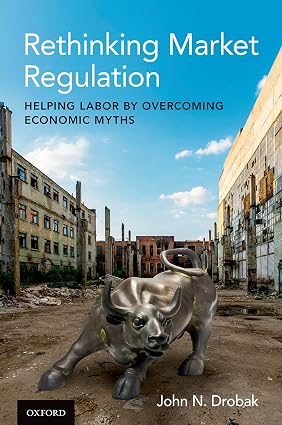
Markets have long been viewed as the engine of economic growth, innovation, and prosperity. For decades, policymakers and economists have argued that less government intervention leads to greater efficiency, stronger competition, and better outcomes for businesses and consumers alike. However, as wealth inequality grows, industries become increasingly concentrated, and workers face new economic challenges, many scholars have begun questioning whether these traditional assumptions still hold true.
In Rethinking Market Regulation: Helping Labor by Overcoming Economic Myths, legal scholar John N. Drobak takes a critical look at the economic theories that have shaped modern public policy. Rather than accepting the idea that markets naturally regulate themselves, Drobak argues that many industries no longer operate under the conditions of true competition. Instead, powerful corporations dominate entire sectors, reducing competition, weakening labor markets, and creating economic policies that often benefit shareholders more than workers.
This insightful and well-researched book challenges conventional wisdom about capitalism and government regulation. It invites readers to reconsider the relationship between businesses, workers, and policymakers while offering practical ideas for creating a fairer and more competitive economy.
About the Author
John N. Drobak is a distinguished legal scholar and professor known for his work in economics, law, corporate governance, and public policy. Throughout his academic career, he has examined how legal institutions influence markets and economic outcomes.
In Rethinking Market Regulation, Drobak combines legal analysis with economic research to challenge long-standing assumptions that have guided American economic policy for decades. His work bridges the gap between economics and law, making complex policy issues understandable for readers interested in business, regulation, and labor rights.
Book Overview
At its core, Rethinking Market Regulation argues that many modern economic policies are based on outdated theories about how markets function. Classical economic models often assume that businesses operate in highly competitive markets where no single company has significant control over prices, wages, or production.
According to Drobak, today’s economy looks very different.
Many industries are dominated by only a handful of corporations. These firms possess enormous influence over employees, suppliers, competitors, and even policymakers. As competition decreases, markets become less efficient, workers lose bargaining power, and consumers often face fewer choices.
The book argues that effective government regulation is not the enemy of capitalism—it is essential to ensuring that markets remain competitive, innovative, and fair.
Challenging Economic Myths
One of the book’s primary goals is to expose what Drobak describes as several “economic myths.”
For many years, policymakers have embraced the belief that reducing regulations automatically produces stronger economic growth. While this may sometimes be true, Drobak argues that the relationship between regulation and economic performance is far more complex.
The book questions assumptions such as:
- Markets naturally correct themselves.
- Competition always protects consumers.
- Large corporations increase efficiency without negative consequences.
- Government regulation always harms economic growth.
By examining real-world evidence, Drobak demonstrates that these assumptions often fail to reflect modern economic realities.
The Problem of Market Concentration
One of the book’s strongest themes is the growing concentration of economic power.
Over the past several decades, numerous industries have experienced waves of mergers and acquisitions. Instead of competing with dozens of rivals, many sectors are now controlled by only a few dominant firms.
Examples include industries such as:
- Telecommunications
- Airlines
- Banking
- Healthcare
- Technology
- Agriculture
When only a few companies dominate an industry, competition becomes weaker.
Without meaningful competition, dominant businesses can often:
- Raise prices
- Limit consumer choices
- Reduce wages
- Slow innovation
- Create barriers for new competitors
Drobak argues that stronger antitrust enforcement is necessary to preserve healthy markets.
Shareholder Value vs. Stakeholder Value
Another central topic is shareholder primacy.
For decades, many corporations have operated under the belief that their primary responsibility is to maximize shareholder profits.
While shareholders are important, Drobak argues that businesses also have responsibilities toward:
- Employees
- Customers
- Communities
- Suppliers
- Society as a whole
When companies focus exclusively on maximizing quarterly profits, they often make decisions that benefit investors while harming workers and local economies.
These decisions may include:
- Outsourcing jobs
- Reducing employee benefits
- Cutting wages
- Closing factories
- Prioritizing stock buybacks over long-term investment
The book encourages readers to rethink the purpose of corporations in modern society.
Helping Labor
Unlike many books about market regulation that focus primarily on businesses, Drobak places workers at the center of the discussion.
He argues that labor markets have changed dramatically.
As corporations become larger and competition decreases, employees have fewer employment options. Reduced competition among employers weakens workers’ ability to negotiate higher wages or better working conditions.
The book suggests that stronger labor protections can improve economic outcomes not only for workers but also for society as a whole.
Some proposed reforms include:
- Greater worker representation in corporate governance
- Better protection for collective bargaining
- Increased transparency during mergers
- Policies that encourage job creation rather than workforce reductions
Rather than viewing labor protections as obstacles to business, Drobak presents them as investments in long-term economic stability.
Rethinking Mergers and Acquisitions
Corporate mergers receive significant attention throughout the book.
Businesses often justify mergers by promising:
- Lower costs
- Greater efficiency
- Improved customer service
- Increased innovation
While these benefits sometimes occur, Drobak argues that mergers frequently produce unintended consequences.
These include:
- Large-scale layoffs
- Reduced competition
- Greater market concentration
- Lower wages
- Fewer opportunities for small businesses
The book advocates for more comprehensive evaluations of proposed mergers, considering not only financial efficiency but also their impact on employment and competition.
Regulation as a Tool for Better Markets
Perhaps the book’s most important message is that regulation should not be viewed as the opposite of free markets.
Instead, regulation helps create the conditions that allow markets to function effectively.
Good regulations:
- Prevent monopolies
- Protect consumers
- Encourage innovation
- Ensure fair competition
- Promote transparency
- Reduce market abuse
Poor regulations can indeed create unnecessary burdens.
However, Drobak argues that smart, evidence-based regulation strengthens capitalism rather than weakening it.
Evidence Over Ideology
Throughout the book, Drobak encourages readers to evaluate economic policies using real-world evidence rather than political ideology.
Instead of asking whether government intervention is inherently good or bad, policymakers should ask:
- Does this policy increase competition?
- Does it improve economic opportunity?
- Does it protect workers?
- Does it encourage innovation?
- Does it benefit society over the long term?
This pragmatic approach distinguishes the book from more ideological discussions about capitalism.
Writing Style
Although the subject matter is academically rigorous, Drobak writes in a logical and accessible manner.
The book combines:
- Economic theory
- Legal analysis
- Historical context
- Public policy research
- Practical examples
Readers without formal training in economics may occasionally find certain chapters challenging, but the author’s explanations remain clear and carefully structured.
The writing is analytical rather than emotional, making it particularly valuable for readers seeking evidence-based arguments.
Strengths of the Book
One of the book’s greatest strengths is its willingness to question assumptions that many people accept without examination.
Rather than arguing for more regulation simply for its own sake, Drobak carefully explains when regulation improves markets and when it may not.
Additional strengths include:
- Thorough research
- Balanced legal and economic analysis
- Clear explanations of complex ideas
- Timely discussion of labor issues
- Practical policy recommendations
The book encourages thoughtful discussion instead of partisan debate.
Who Should Read This Book?
Rethinking Market Regulation is ideal for readers interested in economics, business, and public policy.
It is especially recommended for:
- Economists
- Business leaders
- Corporate executives
- Law students
- Public policy students
- Government officials
- Labor advocates
- Researchers
- MBA students
- Readers interested in corporate governance
Although written from an academic perspective, its ideas are relevant to anyone curious about how markets influence everyday life.
Key Takeaways
Some of the book’s most important lessons include:
- Modern markets are often less competitive than traditional economic theory assumes.
- Large corporations can accumulate excessive market power through mergers and acquisitions.
- Shareholder value should not be the only measure of corporate success.
- Workers deserve greater consideration in business decision-making.
- Smart regulation promotes healthy competition rather than limiting it.
- Public policy should rely on evidence instead of ideology.
- Strong labor markets contribute to long-term economic growth.
CONCLUSION
Rethinking Market Regulation: Helping Labor by Overcoming Economic Myths is a compelling examination of how modern economies function and why traditional assumptions about free markets deserve closer scrutiny. John N. Drobak challenges readers to reconsider whether current regulatory frameworks truly serve workers, consumers, and businesses in an era of increasing corporate concentration and economic inequality.
Rather than advocating for excessive government control, Drobak makes the case for smarter, evidence-based regulation that encourages fair competition, strengthens labor markets, and promotes long-term economic prosperity. His analysis demonstrates that effective regulation and healthy markets are not opposing forces but complementary elements of a well-functioning economy.